PUBLIC WALLS
New York, New York - Inside - Outside - Online
Represented Artists
Jacqueline Rabbiner (American, born 1932)
UPCOMING
Luis Romero
Caribbean Mythologies
Solo Show
New York City - Online
May 1-31, 2026
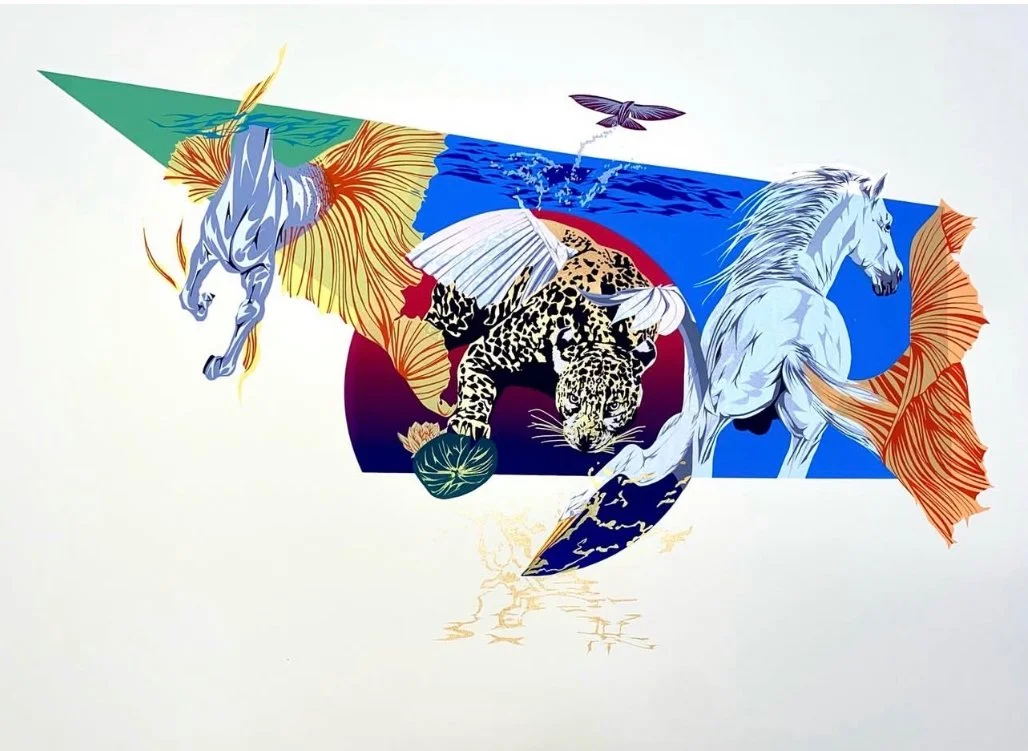
Text from a critique by Gladys E. Ocampo, Art Historian, Museum Expert and Lecturer of the Museo Nacional de Bellas Artes (Buenos Aires, Argentina)
The artistic production of Luis Romero (Colombian), may be understood as a dynamic and chromatically driven visual discourse, in which color assumes a central and structuring role within the poetics of the contemporary Colombian Caribbean. His work operates within a dialectical interplay between figuration and abstraction, where color functions not merely as a formal device but as a symbolic system intimately linked to cultural identity. In this sense, chromatic choices acquire semantic density, articulating meanings that resonate with the socio-cultural context from which they emerge.
Romero’s oeuvre can be situated within a broader narrative of historical resilience, wherein symbolic reconstruction serves as a means of engaging with collective memory and identity formation.
From a formal standpoint, his compositions reveal a complex articulation of geometric planes and abstract structures, resulting in a deliberate fragmentation of pictorial space.
Figures—human bodies, avian forms, and festive scenes associated with Carnival—are subjected to visual tension and perceptual ambiguity, compelling the viewer to actively participate in the reconstruction of the image.
Such compositional strategies recall the formal innovations of Synthetic Cubism and Latin-American Constructivism, while simultaneously incorporating a distinctly Caribbean sensibility. Within this framework, color emerges as the primary agent of meaning, transcending decorative function to convey the experiential and sensory dimensions of the Barranquilla Carnival—characterized by movement, music, dance, and the performative traditions of Congo culture.
Romero’s work also establishes an intertextual dialogue with the oeuvre of Alejandro Obregón, albeit reconfigured through a more ludic and fragmented visual language, one that departs from the latter’s more dramatic and expressionist tendencies.
Furthermore, the artist’s engagement with Caribbean cultural production is intrinsically linked to historical processes such as migration and mestizaje. This connection invites an anthropological reading of his work, foregrounding ancestral cultural frameworks and echoing the structuralist perspectives advanced by Claude Lévi-Strauss, particularly in relation to the persistence and transformation of cultural symbols.
Key works such as Resilience Carnival and Colombia exemplify a process of re-signification of national identity within the field of contemporary art. Romero’s academic formation—spanning the Escuela de Bellas Artes de Barranquilla and the Art Students League of New York—is evident in the synthesis and refinement of his visual language.
His treatment of spatial composition, informed in part by the influence of Pop Art, reflects both formal experimentation and academic rigor, extending across multiple media, including painting, printmaking, sculpture, and mosaic.
From a museological perspective, Romero’s work demonstrates significant potential for both individual and collective exhibitions, given its conceptual coherence and visual impact. Notably, his piece The Light of the Carnival forms part of the collection of the Museo del Carnaval de Barranquilla.
In sum, Romero’s artistic practice succeeds in transcending regional specificity, situating the experiential realities of the Colombian Caribbean within the broader discourse of international contemporary art. His work thus constitutes a compelling example of how localized cultural identity can be articulated and projected onto a global stage, as evidenced by its exhibition at venues such as Rockefeller Center in New York.
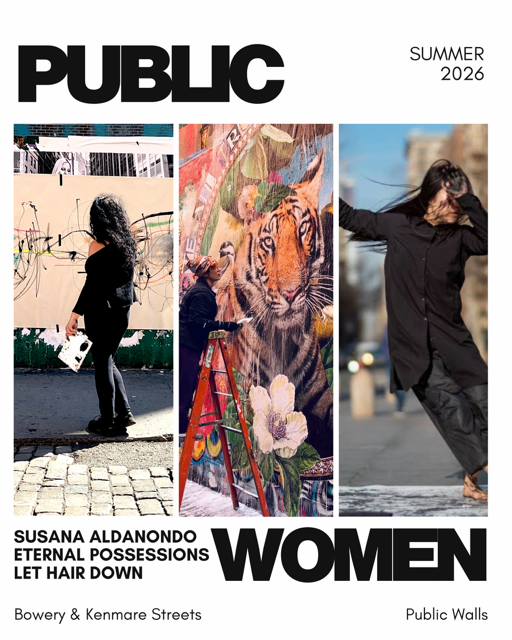
Susana Aldanondo, Kanami Kusajima, Eternal Possessions
Public Women
New York City - Outside: Lower East Side, New York
Bowery & Kenmare Streets
Date: TBD, Summer 2026
If you’re a photographer, critic, writer
If you would like to help us document this exhibition and you are a photographer, critic or writer, please send us a message through
@public.walls
Walls should not separate us
Walls should not be the main goal of an artist’s effort and career
Walls should not act as objects serving only the elite
Walls should reflect the artists and the times of the present
Walls should act as mirrors of the world we live in, and envision
Public Walls as a radical act of extending culture beyond the white cube

A critique is a formal evaluation by an art professional about a body of work.
This formal analysis is the critic’s personal opinion, whether positive or negative, about different aspects of the work. The critique may rely on historical analysis, contemporary art context of the work, but should focus on the creator’s own intention and work.
“I don’t get into ‘becauses.’ When you come into a studio you see a number of works. My habit is to go to the one I like most. If you start to say, ‘because,’ you get into art jargon.”